Key takeaways
- A journal you never reread is a diary you are writing for nobody. The reread is where the value is.
- Speaking gets past the blank page: you cannot delete a sentence halfway through, so the thing you would have edited out stays — and that is usually the entry.
- Keep each entry short and answer three prompts: what happened, what you noticed, what you will do.
- Once a week, read the week back and change one thing. Seven entries and one decision beats thirty entries and none.
How to do it in VoiceNote
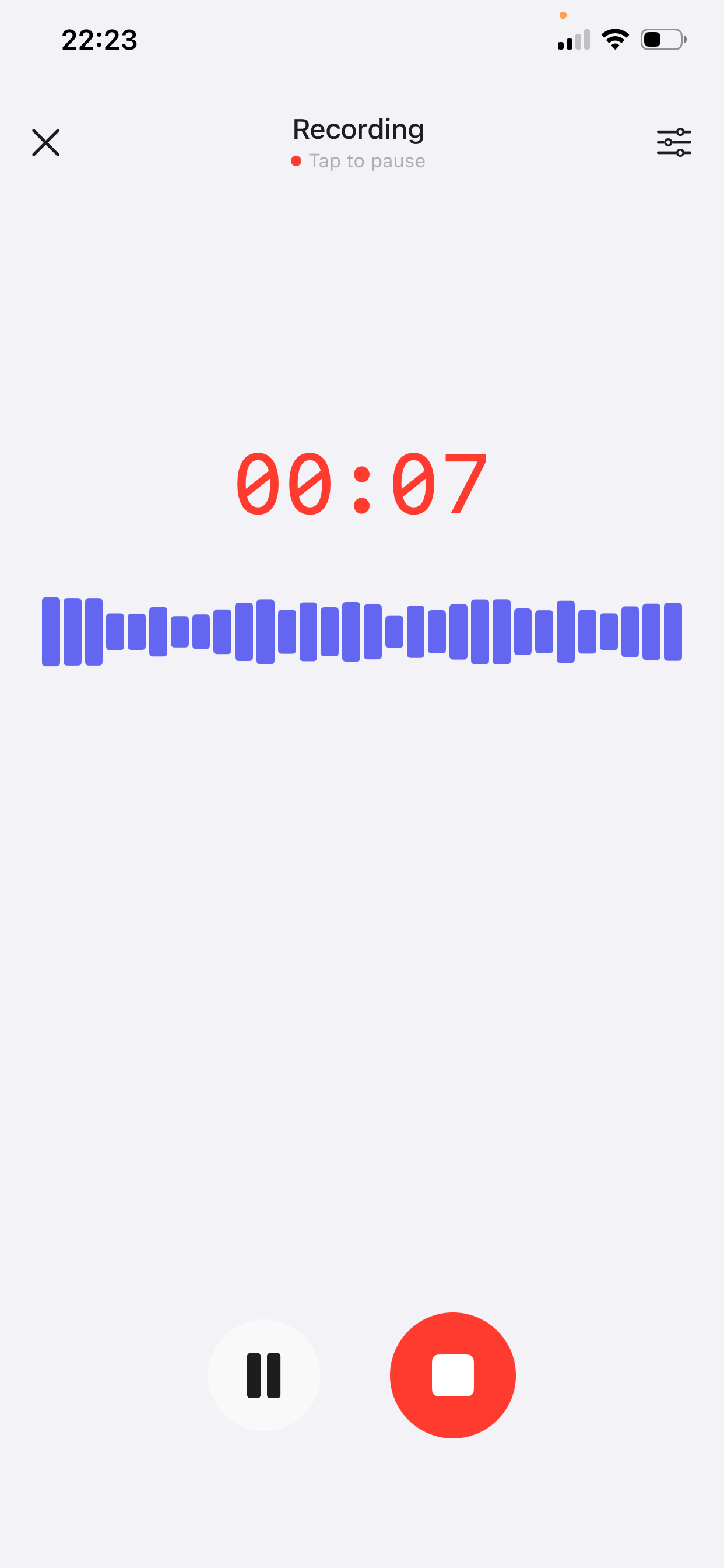
- Tap the mic and talk, untidily. You are not dictating a document; you are thinking out loud. The recording screen keeps the timer in view, which is a useful brake at two minutes.
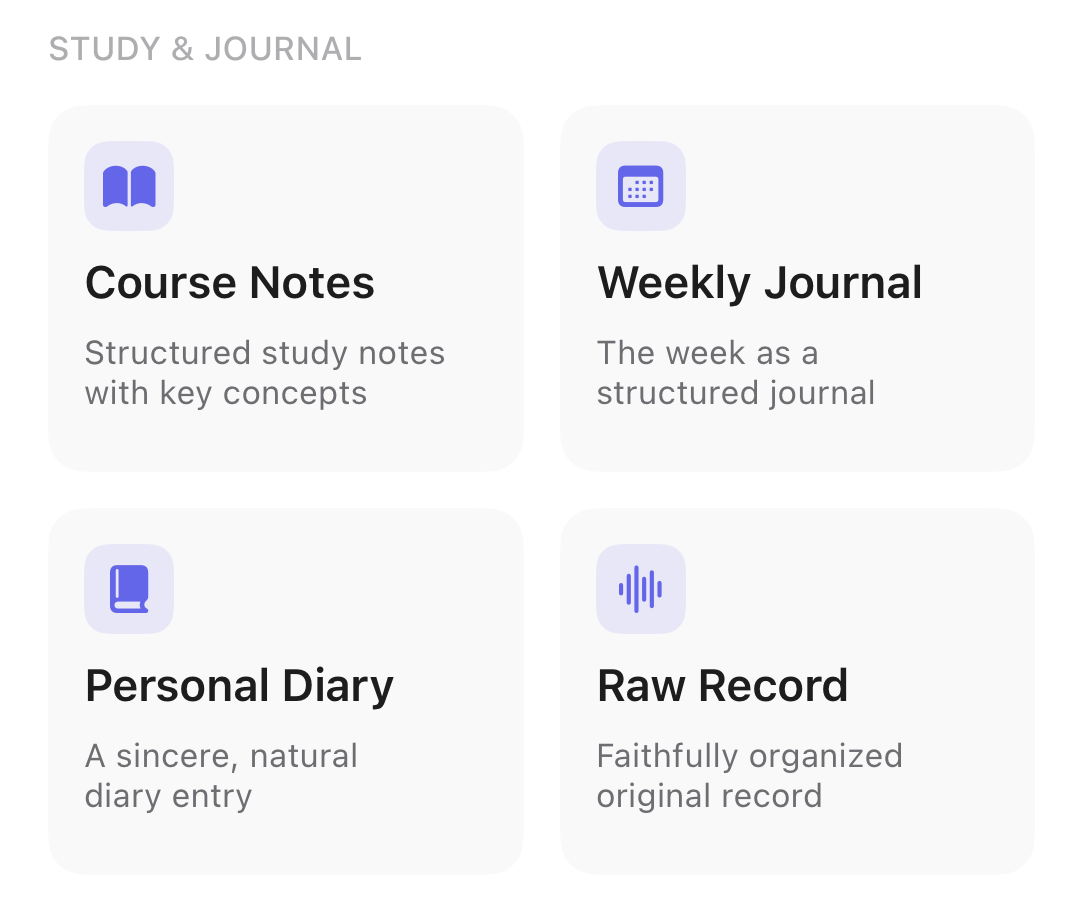
- Use the lightest style you have. This is the one workflow on this blog where you want the least processing. Professional Email works the other way round — it rewrites your speech into something a colleague reads. A journal is for you alone, so choose Raw Record: it organizes the entry faithfully and leaves your sentences as you said them.
- Title it with the date, not the topic. “28 October” sorts itself chronologically. “Busy day” does not, and you will want the order when you read the week back.
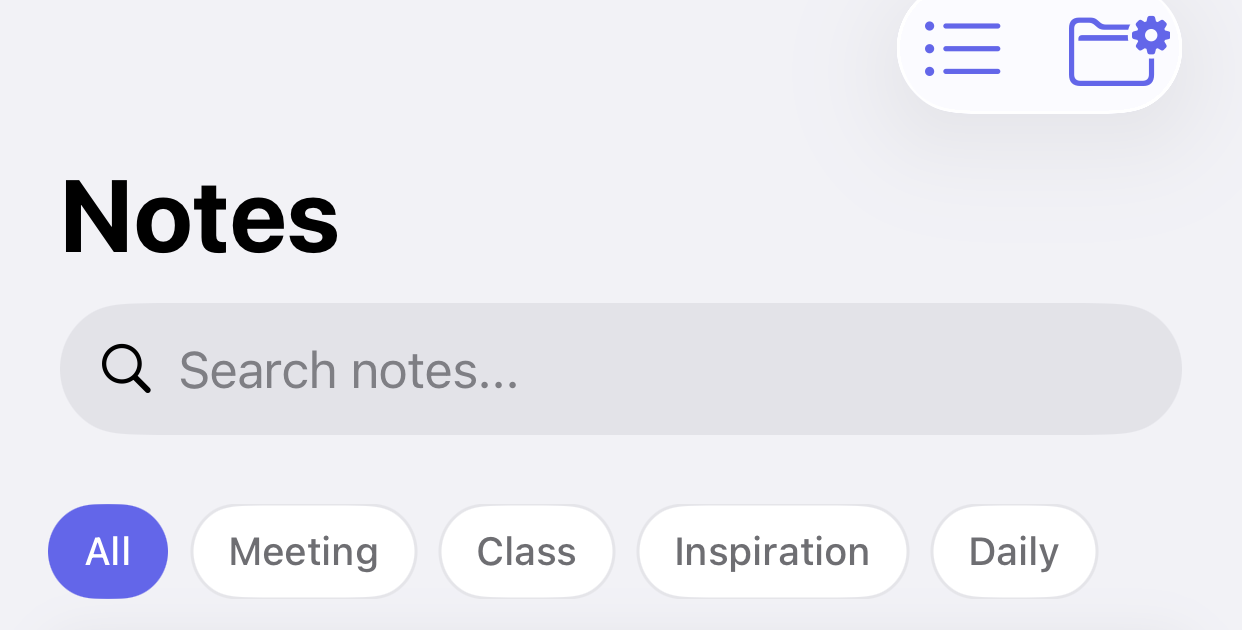
- Tag it Daily. One tag is enough. It turns a pile of notes into a series you can filter, and it makes the weekly read a single tap instead of a search.
- Plan for history. This is the workflow that most needs a long memory: the free plan keeps ten notes and a seven-day history, while Prime has unlimited notes, permanent history and tags. If you are starting a journal rather than testing the app, that is the honest difference.
Why written journals die
A paper journal asks three things of you at once. You have to find the notebook, you have to produce a first sentence with nothing to bounce off, and you have to do both while imagining a reader — because as soon as there is a page, there is someone looking over your shoulder.
None of those costs is high on its own. Together they are enough to kill a habit with no immediate reward. That is the trap: a journal pays out months later, and the cost is charged tonight.
Writing is better for some things. A plan you will act on, an argument you need to check, anything another person will read — type those. A record of what the day was like is not one of them. It has to be cheap, or it will not happen.
What speaking changes
- There is no blank page. The mic is a prompt. “So, Tuesday” is enough to start, and the first sentence does not have to be good.
- You cannot edit yourself into silence. At speaking speed the sentence you would have deleted arrives before you can stop it: “the review was fine — actually no, the part that bothered me was…”. That actually is the entry. Written down, it never survives.
- Tone keeps the fact. Flat text loses how something felt. Spoken, the sigh and the rush are still in it, and you hear them again in the reread.
- Two minutes is a real entry. A journal that costs two minutes survives a bad week. One that costs twenty does not survive a good one.
The daily three
Three prompts, answered in order, then stop. No warm-up, no summary at the end:
- What happened? Facts only, in the order they happened. Two sentences is a full answer.
- What did I notice? Not the event but your reaction to it — the thing you kept turning over, the part you avoided saying out loud.
- What will I do? One action, small enough to start tomorrow. If it needs a plan, it is not a journal entry yet.
The stop matters as much as the questions. An entry ends when the thought ends. Do not pad it to feel productive, and do not add “overall it was a good day” to round it off — that sentence is filler, and filler is the first thing that makes a journal boring to reread.
A worked example
An entry from a Tuesday, spoken on the walk back from a review, including the correction nobody would write down:
Spoken entry
“Okay, Tuesday. The review was fine, I think. Actually no — what bothered me is that I spent the whole meeting defending the timeline instead of asking whether the timeline was the question. Nobody asked what we would cut. Second thing: I said yes to the extra workshop without checking the calendar, and I do that when the person asking is senior. And what I notice is that I am tired in a way that is not about sleep, it is about too many open loops. Tomorrow: before I say yes to anything new, I write down what I would drop to fit it.”
The entry
Tuesday 28 October
What happened
- The review went well on the surface; I spent it defending the timeline.
What I noticed
- Nobody asked what we would cut, and neither did I.
- I said yes to the extra workshop without checking my calendar — I do that when the person asking is senior.
- Tired from open loops rather than from lack of sleep.
What I will do
- Before accepting anything new, write down what I would drop to fit it.
What changed: two rambling minutes became three lines you can act on — and the phrase that would never have survived on paper, “actually no”, turned out to be the whole point.
The weekly review
This is the step that turns a diary into a system, and the one almost everyone skips. Ten minutes on a Sunday, in this order:
- Read the week in sequence. All seven entries, oldest first, without stopping to fix anything. You are looking for the shape, not judging the sentences.
- Mark three things. A word that keeps appearing, an event that keeps recurring, and something you wrote around without ever writing into. The third one is usually the useful one.
- Run the week through Weekly Journal once. The style turns the pile of entries into one structured week so you can check your reading against it — and the same move as testing yourself on your notes instead of rereading them.
- Write three lines and close the week. The theme, the thing you avoided, and one change. The change has to be one sentence and one action: “ask what we would cut”, not “communicate better”.
It is the same rule as writing up a meeting: what you keep is the decision, not the words. A week of entries that produces no decision is a transcript of your life with no minutes.
Mistakes to avoid
- Writing for an audience that is not there. The moment an entry is addressed to somebody else it stops being a journal and becomes performance.
- Performing insight. “I learned today that consistency matters” is a poster, not a reflection. Name the specific moment instead.
- Rereading every day. The daily entry is the input. The weekly read is where it pays, and doing it daily turns the ritual into another task.
- Editing the entry into prose. Filler is noise, but your blurted half-sentences are the content. Keep the second and delete only the first.
- Chasing a streak. A missed day is not a broken chain. The habit is the next entry, not the unbroken run.
Frequently asked questions
Do I have to record every day?
No. Three or four entries a week are enough to see a pattern, and the weekly read is what makes the practice worth keeping. A journal you skip is still a journal; one that guilt-trips you is not.
What if I do not like hearing my own voice?
Then never play the audio back. In this workflow the transcript is the artifact and the recording is only the receipt. Read the text, correct a name if the transcription missed it, and close it.
Is a voice journal private?
Treat it like a paper diary: it is personal, and it is only as private as your phone and your backup settings. Check the app’s privacy policy for how recordings are processed, and do not say anything in an entry you would not want forwarded.
Can I journal in a language I do not write well?
Yes, and it is one of the better uses of the 46-language support: speak in the language you think in, and the transcript will be in that language. Many people reflect more honestly in a second language, because the words for the feeling are less worn.
How long should an entry be?
Long enough to finish the thought, which is usually under three minutes. Past that you are probably drafting a memo or a letter — which is useful, but it is a different workflow and it belongs in a different note.
Start the habit tonight
Download VoiceNote, talk through your day for two minutes, and read the week back on Sunday.
Download on the App Store