Key takeaways
- Study notes are a test, not a record: if you cannot answer from them, they are a transcript.
- Record in short passes, one per section, and say the structure out loud — “the second point is…”.
- Course Notes sorts a recap into key concepts, definitions and examples; you add the questions.
- Turn every concept into a question. Rereading feels like studying; answering does not lie.
Recording a lecture feels like a safety net. Whatever you miss, you can listen back to. In practice, almost nobody does: a ninety-minute audio file is a worse revision tool than a blank page, because it rewards the feeling of having captured something without asking you to understand it.
The useful middle step is a page of notes you can test yourself with. It takes about fifteen minutes after the lecture, and it is the difference between having material and having studied.
Why a transcript makes a poor study aid
A transcript is flat. Every sentence weighs the same, so the one definition that the exam turns on sits next to a tangent about the projector. There is no hierarchy, no emphasis, and nothing that tells you what you are supposed to do with it.
Worse, it invites rereading. Rereading feels productive because the material becomes familiar, but familiarity is not recall. You recognise the paragraph when you see it and discover on the exam that you cannot reproduce it.
Notes work the other way round. They compress the lecture into concepts, attach a definition and an example to each one, and then ask you to answer questions with the notes closed. That last step is doing the actual studying, and it is the one most people skip.
It is the same gap as writing up a meeting: what people need is the outcome, not the words.
How to do it in VoiceNote
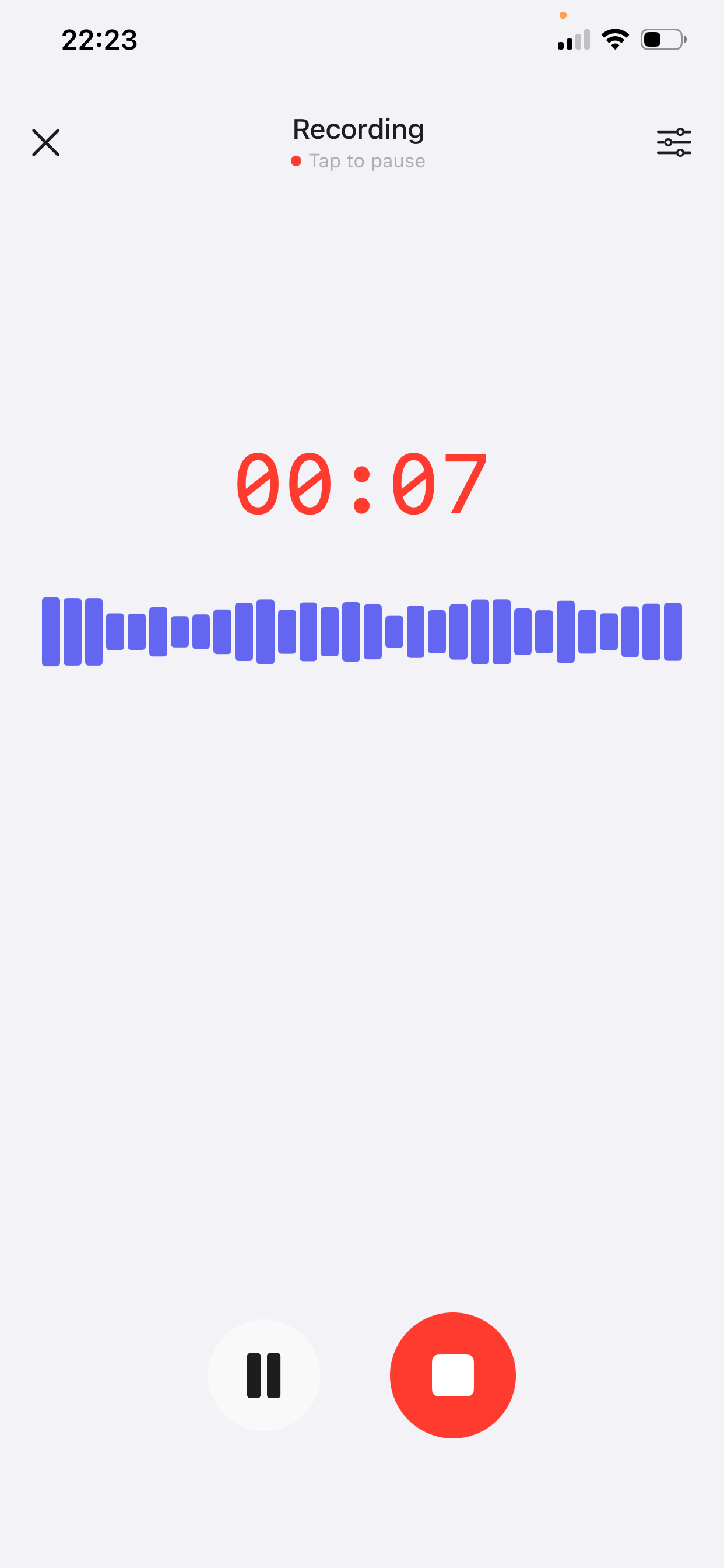
- Record section by section. Open VoiceNote (first time? Download it here), tap the mic and recap. The free plan includes 10 notes of up to 2 minutes each; Prime removes the note limit and extends recordings to 15 minutes. Three or four notes cover a fifty-minute lecture.
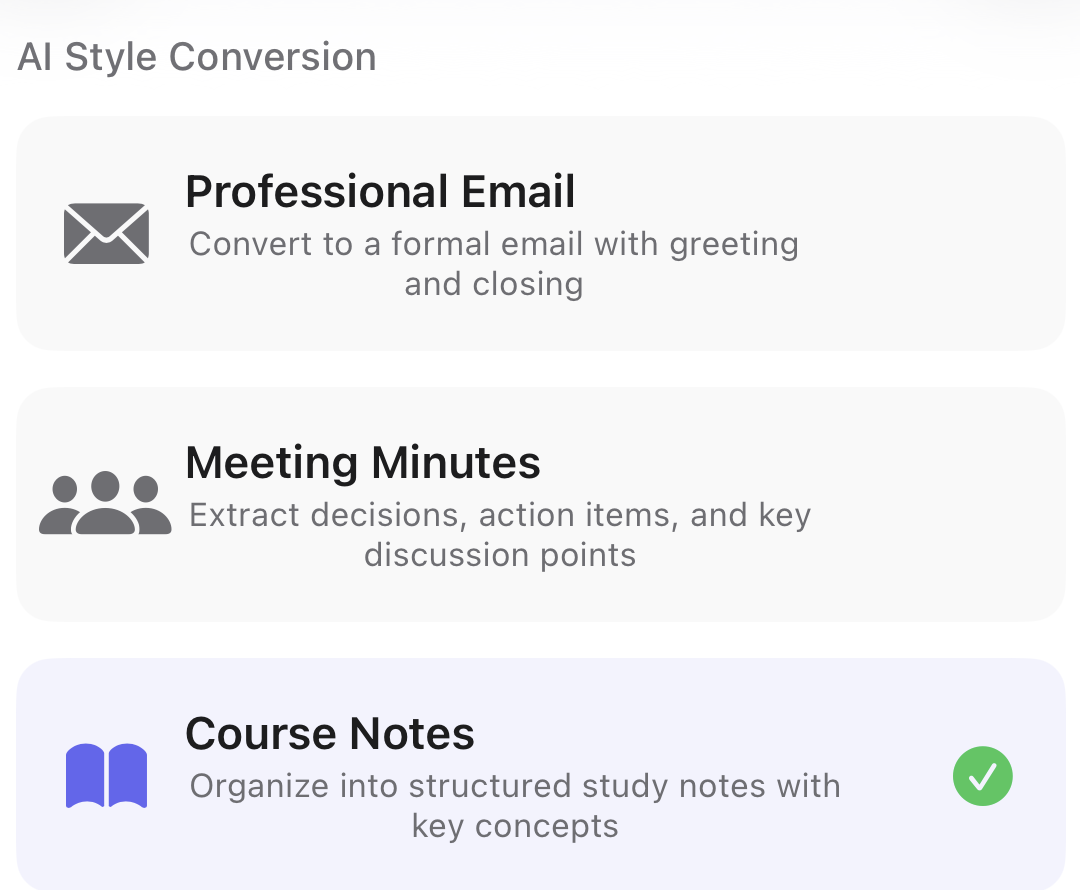
- Choose Course Notes. The style in VoiceNote turns the recap into structured notes with key concepts instead of a wall of text.
- Fix the jargon. Technical terms, names and numbers are where transcription slips. Keep a glossary line at the top of the page and check each term once.
- Add the questions yourself. The style can organise ideas; only you know what your exam or project will ask. Five questions per lecture is enough to start.
- File it where you will look. One page per lecture, named with the course and the date, in the same place every week.
Record so the notes write themselves
The quality of the notes is decided during the recap, not afterwards. Four habits make the difference:
- One note per section. Do not record ninety minutes in one file. Pause at each natural break in the lecture and recap that section while it is still fresh. Short takes are easier to review and much easier to correct.
- Say the structure out loud. “The second point is…” “This connects to…”. Transcription keeps those markers, and they become the skeleton of your notes.
- Define in your own words. If you repeat the lecturer's sentence verbatim, you have recorded a quote, not understanding. Say what the idea means as if explaining it to a friend.
- Name the examples, and where they came from. “The Gorilla experiment from the first reading” survives. “That study he mentioned” does not.
Do not stop to look things up mid-recap. Note the gap instead — “I need to check what encoding means here” — and it becomes a question on your list.
The four passes
- Speak the recap. Two to four minutes per section, straight after the lecture, in your own words.
- Apply Course Notes. The style organises the recap into structured study notes with key concepts.
- Rebuild the map. Every concept needs three lines: what it is, an example, and why it matters. If one is missing, that is a gap, not a detail.
- Turn each concept into a question. “Retrieval practice” becomes “Why does testing yourself beat rereading?” This question list is what you revise from — the notes themselves are just the answer key.
A worked example
A fifty-minute lecture on memory, recapped in one two-minute note twenty minutes later — including the part where the speaker lost the thread, which is normal and harmless.
Spoken recap
“Okay, lecture three, memory and learning. The main idea is that retrieving something changes it, that's retrieval practice — testing yourself makes the memory stronger, not just measures it. Um, the evidence was the Roediger and Karpicke study, students who tested themselves remembered more a week later than students who reread, even though the rereaders felt more confident. Confidence is the trap, that's the key point. Second idea is spacing: the same total study time spread out beats one block, and the gap should be long enough that you almost forget. There was a graph of that but I didn't catch the numbers. I need to check what 'desirable difficulty' means exactly, he used it twice. Exam hint: she said the essay question would be on why rereading fails.”
Study notes after the style
Lecture 3 — Memory and learning
Key concepts
- Retrieval practice — recalling information changes and strengthens it.
- Spacing — the same study time spread across days beats a single block.
- Desirable difficulty — effortful recall is what produces learning.
Evidence
- Roediger & Karpicke: students who self-tested recalled more a week later than students who reread — while feeling less confident.
Check yourself
- Why does testing beat rereading, even when rereading feels easier?
- How long should the gap be between two study sessions?
- What does “desirable difficulty” mean, exactly? (look up)
- Essay prompt flagged in class: why rereading fails.
What changed: a spoken paragraph became three concepts, one piece of evidence and four questions. The missing graph and the unclear term are recorded as gaps instead of being smoothed over.
Notes you can actually revise from
- One page per lecture. If it runs longer, you are keeping detail you will never revise. Move it to an appendix or drop it.
- Your words, not the slides'. A copied definition is a definition you cannot use in an exam answer.
- An example beside every concept. Examples are what you retrieve under pressure when the definition will not come.
- A visible “check yourself” list. Questions on the page, answers in your head. That is the revision session.
- Date and source on every page. Lecture number, reading, week. In three months that context is gone.
Mistakes to avoid
- Recording the lecture and calling it notes. An untouched audio file is a plan to study later, and later rarely comes.
- Highlighting the transcript. Colour is not compression. Rewriting in your own words is.
- Recapping a week later. The value of a recap drops fast; the connections you made in the room are gone by the next day.
- Writing notes with no questions. Reading notes is the weakest form of revision. Answering from them is the strongest.
- Letting the gaps disappear. “I need to check…” is the most valuable line on the page. Do not edit it out.
Frequently asked questions
Can VoiceNote record a whole lecture?
Not in one file. The free plan gives 10 notes of up to 2 minutes each; Prime has unlimited notes and recordings up to 15 minutes. Recording section by section is better anyway: each recap is short, focused and easy to correct.
What about technical terms and accents?
They are the usual weak spot. Say terms clearly, keep a glossary line at the top of the page, and check every term once against the slides or reading. A two-minute proofread is cheaper than revising from a wrong definition.
Which languages does VoiceNote support?
46 languages for transcription and polishing, so you can recap in the language the lecture was given in — or in the one you think in, if that helps you explain the idea faster.
Can I share the notes with classmates?
Yes, and it is a good test: if a classmate can answer your questions from the page without asking you, the notes work. Check names and numbers before you send them, since errors spread fast.
Is it okay to record a lecture?
Ask. Many universities leave it to the lecturer, and some courses forbid it. Say what you are recording for, keep the audio to yourself, and follow the course policy.
Turn today's lecture into notes you can revise from
Download VoiceNote, recap each section on the way out, and write the questions while the lecture is still fresh.
Download on the App Store