Key takeaways
- Your memory keeps the conclusion and loses the sentence. Record the sentence.
- Ask before you record, and say what happens to the file afterwards.
- Raw Record keeps the wording that makes a quote usable; it does not decide what matters.
- Separate what they said from what you think — in the note, not only in your head.
Interview notes go wrong in a predictable way. You finish the call, write ten minutes of notes, and the notes are smoother than the interview was: your summary, your framing, your conclusion. A week later you need the sentence that made you believe it, and it is gone.
Recording fixes that, as long as you are honest about permission and disciplined about the record. The transcript is not the deliverable; it is what stops you from replacing a participant's words with your own.
How to do it in VoiceNote
Step 1 — Ask, then record the part that matters
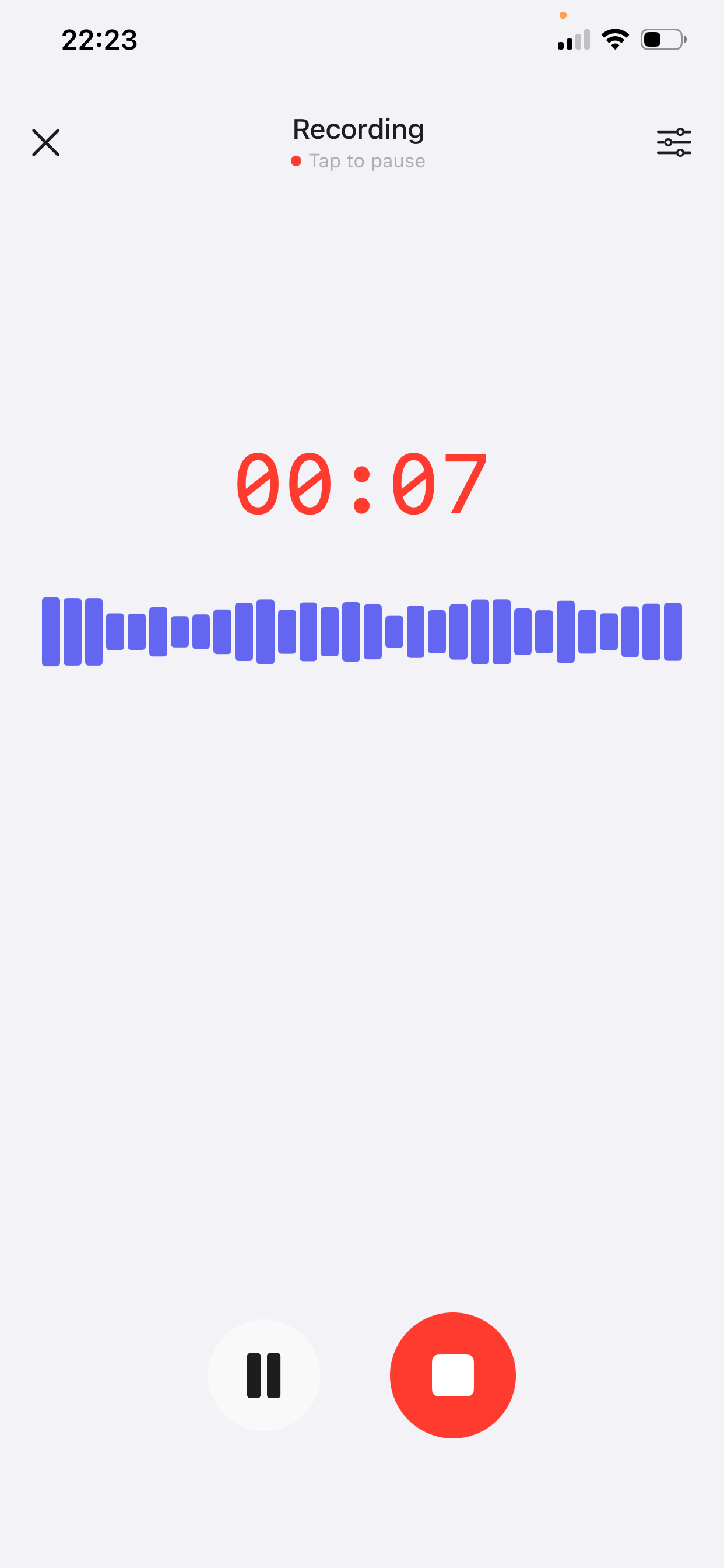
Before anyone speaks a word, ask whether you may record, explain what the recording is for, and say when you will delete it. Then open VoiceNote and tap the mic. The free plan records up to two minutes per note; Prime extends a single recording to fifteen, so either record in segments or capture the sections where the person stops giving short answers.
- Record the story, not the small talk. “Tell me about the last time that happened” produces a usable minute; the introductions do not.
- Note the context out loud first. Say the date, the participant's role, and the question you are on — one sentence at the start of each segment saves an hour of reconstruction later.
- Say what you are thinking when you stop. “That felt different from the last interview” is legitimate research data, as long as it is labelled as yours.
- Ask the person to repeat a quote you will use. One sentence, verbatim, is worth twenty paraphrases.
Step 2 — Apply Raw Record
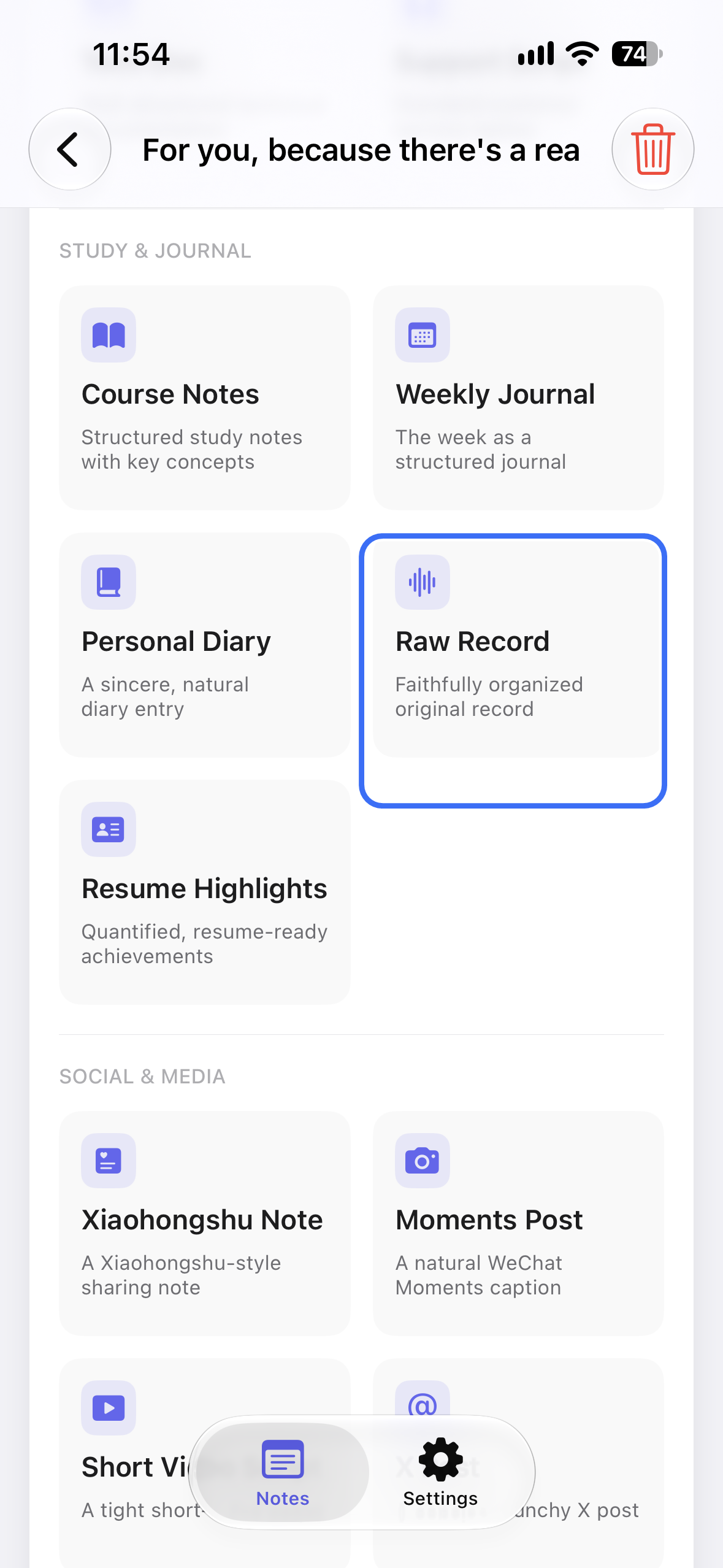
Open the note, tap AI Style Conversion and choose Raw Record. The style produces a faithfully organised record of what was said: the words kept, the order kept, tidied into something readable rather than compressed into a takeaway.
That is the right choice for research and the wrong one for a meeting summary: you want the participant's phrasing, not a polished version of it. Read the record against your memory and correct anything the transcription flattened — a name, a number, the tool they named twice.
Keep a second, clearly separated note for your interpretation. Mixing the two is how a finding becomes an assumption: six weeks later nobody can tell which sentences came from the participant and which came from you.
Step 3 — Pull out quotes, decisions and surprises
After the record exists, mark three things: the quotes you would put in a slide, the facts you will rely on, and the moments that contradicted what you expected. The third list is the one that changes the project.
Anonymise before anything leaves the page — names, employers, anything that identifies the person. A quote is only usable if the person who said it is not identifiable from the rest of your notes.
Why the notes decay
Memory is a summariser. By the time you write up the interview, it has already decided what mattered, and it remembers the version of the conversation that supports that decision. The details that survive are the ones that fit the story you were already telling.
The transcript is not neutral either — it records what was said, not what was meant. But it is a fixed record, so two people can disagree about the interpretation without disagreeing about the evidence. That is what makes research notes useful to anyone other than the person who took them.
Speaking also preserves the mess: the hesitation before an answer, the correction halfway through a sentence, the thing they said and then walked back. In a written note those disappear; in a transcript they stay, and they are often where the real finding is.
A worked example
A made-up example. A product researcher records the second half of a 25-minute call with a participant.
Spoken segment
“Okay, this is segment three, Tuesday, participant is a warehouse coordinator, we are on the question about the weekly stock count. She says — and I am repeating this back to check — ‘the count is not the problem, the problem is that I do it three times, once for the system, once for the spreadsheet, and once for my manager, because he does not trust either of them.’ Then she said the reconciliation takes her most of Thursday and that she has stopped flagging discrepancies because nobody acts on the flags. My impression: the pain is not the counting, it is that the same number has three different owners. I want to check this in the next two interviews.”
Raw Record entry
Participant
Warehouse coordinator · second half of call, 25 minutes · Tuesday
What she said
“The count is not the problem, the problem is that I do it three times — once for the system, once for the spreadsheet, and once for my manager, because he does not trust either of them.”
Reconciliation takes most of Thursday. She has stopped flagging discrepancies because no one acts on the flags.
Researcher's note (mine, not hers)
The pain looks like ownership of the number, not counting effort. Check in the next two interviews.
What changed: the quote stays a quote, the interpretation is labelled, and the next step is written down while it still seemed like a good idea.
Before you close the file
- Delete the audio when the study allows it. You promised a date; keep it.
- Write one line you would defend in a meeting. If the entry has no claim, it has no finding — that is what the next interview is for.
- Note what you changed your mind about. A record of your own shift is the most convincing thing in a research readout.
Mistakes to avoid
- Recording without asking. It ends the interview's trust and, depending on where you are, more than that.
- Recording everything and transcribing nothing. Two hours of audio you never open is not a record.
- Tidying the participant's grammar in a quote. A quote is evidence; editing it makes it your sentence.
- Blending your interpretation into the quote block. Separate them, visibly.
- Keeping identifiable details “for context”. Context is what makes a quote unsafe to publish.
Frequently asked questions
Can VoiceNote transcribe a whole interview?
A single recording is limited — two minutes on the free plan, fifteen with Prime — so long interviews are recorded in segments, each with a spoken note about what it covers.
Is recording an interview legal?
It depends on where you are and what the interview is for. Ask for permission, explain the purpose, and follow your organisation's research policy; this article is workflow, not legal advice.
How is this different from meeting minutes?
Minutes compress a conversation into decisions and owners. An interview record keeps the participant's words, because the wording is the data.
Should I send the record to the participant?
If you promised to, yes — and it is a good check on anything you paraphrased. Anonymise before sharing more widely.
What if the transcription gets a name wrong?
Correct it in the note while you remember; a wrong name undermines every quote around it.
Which languages does VoiceNote support?
VoiceNote transcribes 46 languages. Record in the language of the interview; the style names in the app stay in English.
When the notes are ready, summarising them for the team in an email is the next step — and the quotes are what will get read.
Keep what they actually said
Download VoiceNote, record the parts of the conversation that matter, and keep a faithful record instead of a summary of your own impressions.
Download on the App Store