Key takeaways
- A summary written with the source open is a copy with fewer words.
- Recap out loud from memory first — it shows you what you actually understood.
- Content Summary compresses the recap into concise key points; it does not verify them.
- Every summary needs a source line and one sentence about what you will do differently.
Most reading notes are transcriptions with the sentences shortened. You read a report, you highlight, you copy the highlights into a document, and you end up with the author's structure in a different font. Nothing in it is yours, so nothing in it sticks.
The alternative is a two-minute test: close the material and say what it said. Whatever comes out is what you understood. Then build the summary from that, not from the page.
How to do it in VoiceNote
Step 1 — Close the source and recap from memory
Put the article, report or book down — closed, face down, out of sight. Open VoiceNote, tap the mic and talk for one or two minutes. The free plan records up to two minutes per note; Prime extends a single recording to fifteen, which is enough for a long chapter or a whole report.
- Say what it was about in one sentence. If you cannot, that is the finding: you need to read it again, not summarise it.
- Name the three things that stayed. Not the three most important — the three you remember. The gap between those is your reading list.
- Say what you disagreed with. Disagreement is the sign you were thinking rather than collecting.
- Say who should read it and why. One sentence: “the ops team should read the section on lead times.” That sentence is often the only part anyone else needs.
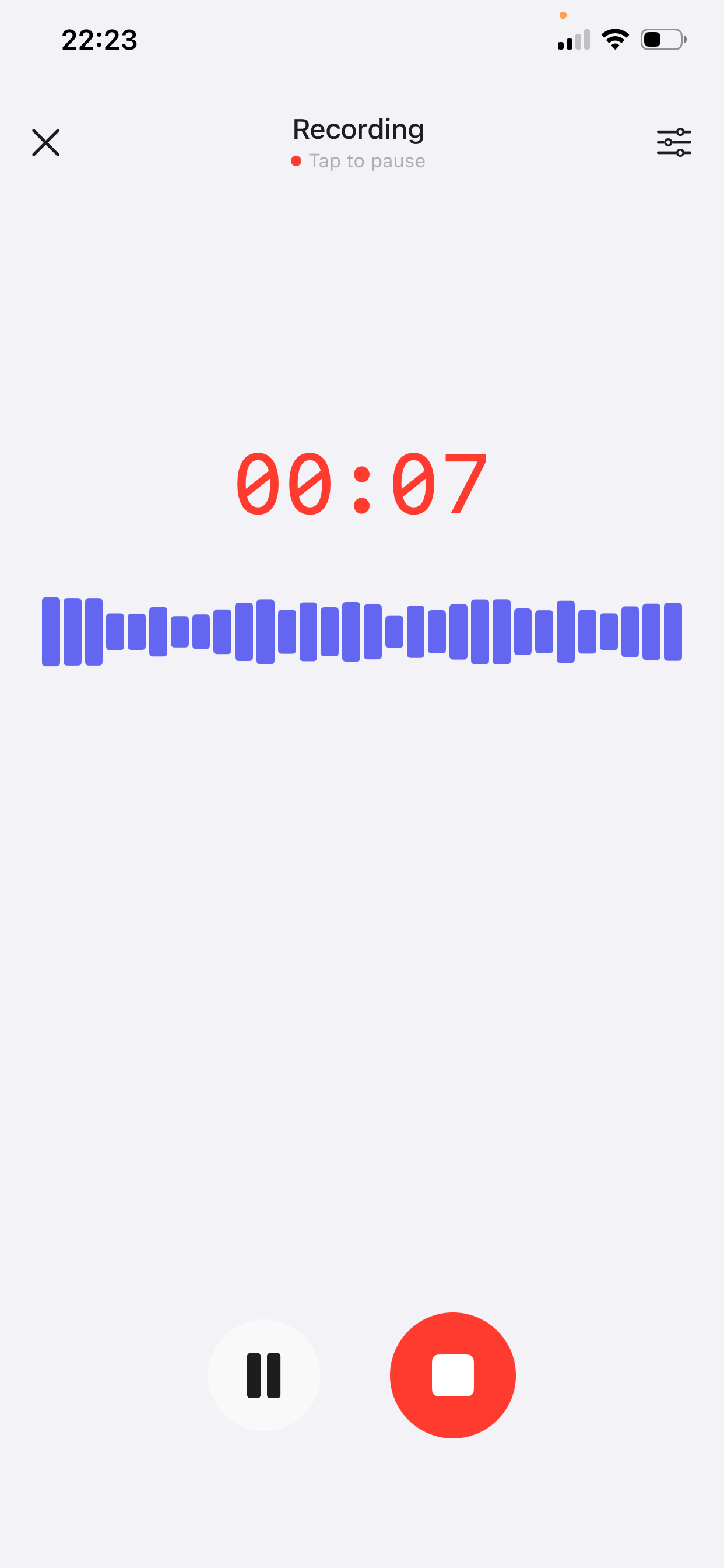
Step 2 — Apply Content Summary
Open the note, tap AI Style Conversion and choose Content Summary. The style turns the recap into concise key points: your phrasing, tightened, in the order you said it.
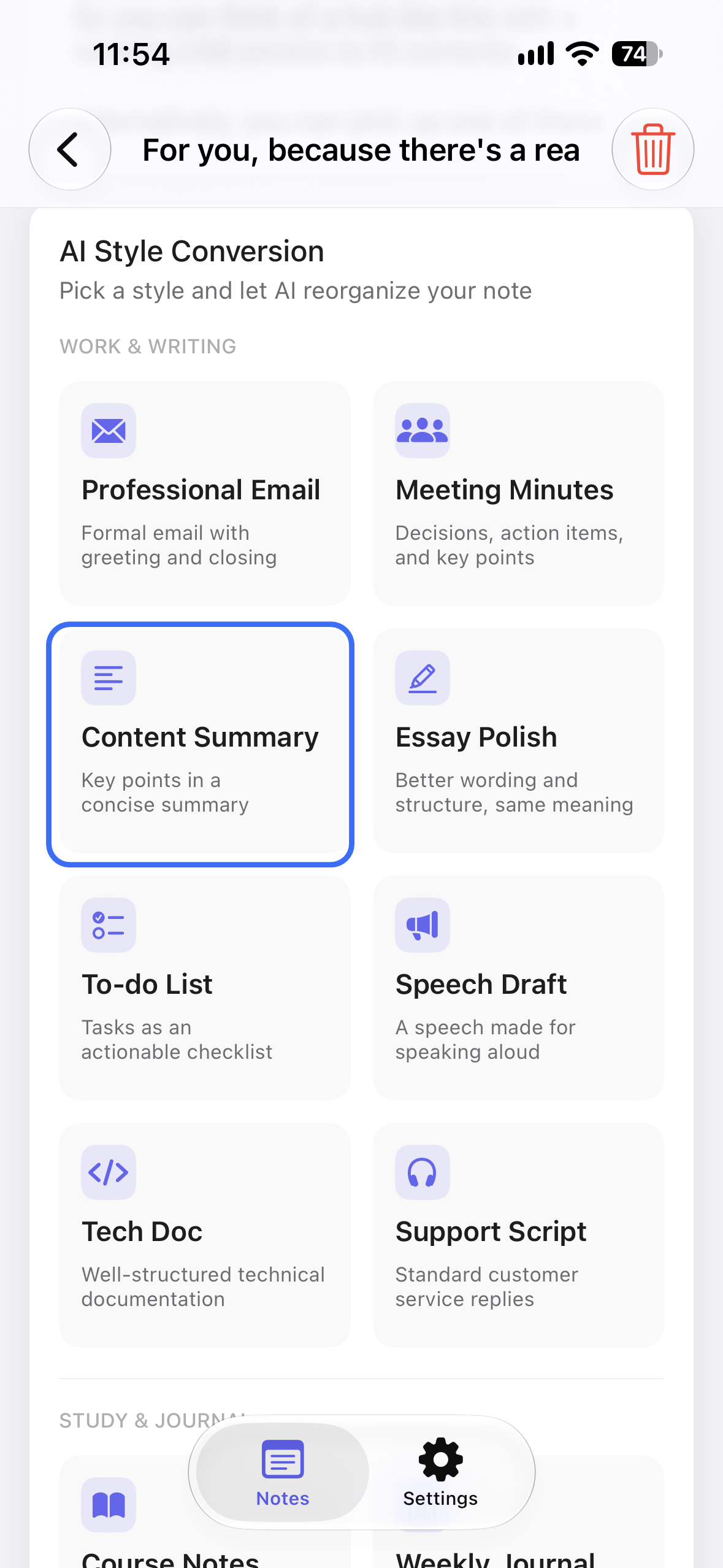
Read the key points against the source once, and correct what memory blurred: a number, a name, the direction of a comparison. This is the only step where you are allowed to look — and the only reason to look is accuracy, not wording.
The style compresses what you said; it will not tell you whether your recap was right, and it cannot add the part you never understood. If a point looks thin, that is information: go back and read that section properly.
Step 3 — Finish it so it is usable later
Three edits and the summary is done:
- Make each point stand alone. A key point that only makes sense next to the section it came from is not a summary; it is a bookmark.
- Add a source line. Title, author, where you found it, the date you read it. Future you will want to check a claim and will not remember where it came from.
- Add one line of consequence. “So I will shorten the report to two pages before the planning meeting.” A summary with no consequence is a file, not a decision.
Why saying it out loud is the summary
Reading produces recognition: the page feels familiar, so you assume you know it. Recall is different — it requires the idea to exist in your own words, and that is what a summary is for.
Speaking forces recall and paraphrase at the same time. You cannot read a sentence off a page you are not looking at, so whatever you say has already passed through your understanding. If it comes out vague, the understanding was vague.
It also preserves the judgement that reading notes usually lose: what you doubted, what surprised you, what you would have to check. Those reactions are the reason a summary is worth keeping after the source is forgotten.
A worked example
A made-up example. A team lead skims a thirty-page industry report the evening before a planning meeting.
Spoken recap, source closed
“Okay, this is the Halden report, thirty pages, I read it on the train. Main thing: the shortage is not materials, it is scheduling — everyone is ordering the same things at the same time. There is a chart around page nine about lead times going from six weeks to fourteen, and I want to check that number because it felt high. Second thing: the report says small suppliers are the ones who get squeezed, because they cannot hold stock. Third: they recommend shared forecasting, which sounds sensible but it needs everybody to share their numbers, and I do not see our two main suppliers doing that. I disagreed with the bit where they call it a temporary problem. Nothing about this looks temporary. Page count: I would say the whole thing is two pages of content and twenty-eight pages of charts.”
Content Summary, after checking the source
Halden, “Supply scheduling in 2026” · read Nov 16, link in the reading list
1. The bottleneck is scheduling, not materials — everyone orders at the same time.
2. Lead times moved from six weeks to fourteen (chart, p. 9). Verify before quoting.
3. Small suppliers absorb the damage because they cannot hold stock.
4. The fix they propose — shared forecasting — requires all parties to share numbers. Unlikely with our two main suppliers.
My view: they call it temporary; it does not look temporary to me.
So: use points 1 and 3 to open the planning meeting, and ask procurement about the fourteen weeks.
What changed: the summary is in the reader's words, the doubted number is flagged rather than repeated, and the last line turns it into something to do.
Before you file it
- Check every number you plan to repeat. Memory rounds numbers in the direction of the story.
- Mark what is the author's and what is yours. Two lines are enough: “The author…” and “I think…”.
- Send the summary, not the highlights. If someone else needs the source, they can read it; what they cannot do is see why it mattered.
Mistakes to avoid
- Summarising with the page open. You will copy the structure and learn nothing.
- Keeping every point. A summary of everything is a smaller version of the problem.
- Recording a summary of a summary. If you only read someone else's thread, say so in the source line.
- Letting the style be the thinking. Compression is not comprehension; the test happened in step 1.
- No source line. An unattributed claim is one you cannot defend six months later.
Frequently asked questions
How long should the recap be?
One or two minutes for an article, up to fifteen for a report or a chapter. If a recap takes longer than that, you are retelling the source rather than summarising it.
Does it work for podcasts and videos?
Yes — listen or watch first, then record the recap with the audio paused. Summarising while it plays becomes transcription.
How is this different from study notes?
Study notes are structured notes with the concepts laid out for learning. A content summary is shorter and aimed at reuse: what the thing said, what you think of it, and what you will do about it.
And from meeting minutes?
Minutes record decisions and owners from a conversation. A content summary records a source you consumed — no owners, no deadlines, just the argument and your reaction to it.
Can VoiceNote summarize the original document for me?
No. VoiceNote works from your recording, so the summary is a tightened version of what you said. That is the point: the understanding has to come from you.
Which languages does VoiceNote support?
VoiceNote transcribes 46 languages. Summarise in the language you read in; style names in the app stay in English.
If the material is for a course rather than a one-off read, structured study notes will serve you better than a summary.
Say it before you write it
Download VoiceNote, recap what you read from memory and turn it into key points you can trust — because you said them without the page in front of you.
Download on the App Store